What is Medallion?
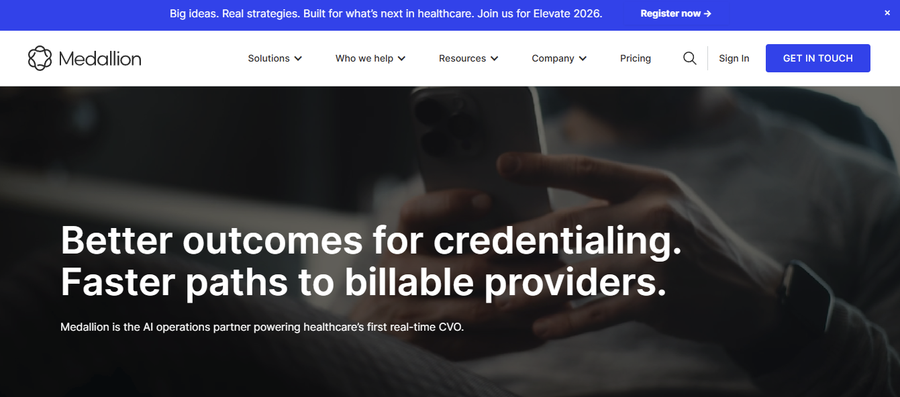
Medallion is an AI-assisted credentialing platform built around an NCQA-certified Credentials Verification Organization (CVO), combining AI agents with credentialing experts to manage credentialing, payer enrollment, licensing, and provider monitoring.
Medallion features
Medallion bundles credentialing, enrollment, licensing, and monitoring into a single platform, powered by AI agents with expert oversight. For healthcare ops teams, what matters is where each capability fits credentialing, enrollment, or licensing workflows and where it falls short.
- CVO credentialing: Combines AI agents that automate primary source verification with credentialing specialists who review critical stages, generating NCQA-compliant files in real time. Strong for organizations wanting a fully managed CVO with SLA guarantees.
- Payer enrollment automation: Submits and tracks applications across commercial and government payers, with status updates flowing back into the platform. Useful for health companies enrolling providers across dozens of payers.
- Cross-state licensing: Automates license applications, renewals, and live tracking across states, including IMLC, DEA, and CSR registrations. Built for health firms expanding into new states, but document handling within the platform creates findability issues as licenses are continuously verified and re-verified.
- Delegated credentialing: Manages NCQA-compliant workflows with full audit visibility, automated PSV, and committee management tools. Strong for health systems and large provider groups running delegated agreements with payers, where reportable committee tools and audit readiness matter most.
- Roster management: Ingests, standardizes, and validates provider rosters across entities, syncing with health plans without manual effort. Useful for consolidating fragmented roster data from spreadsheets or legacy systems, though best paired with credentialing or enrollment rather than used as a standalone capability.
- Real-time compliance monitoring: Sends alerts on credential expirations, sanctions, and license issues across the provider network. Strong for risk management at health systems with regulatory exposure.
- CredAlliance: Medallion's national credentialing clearinghouse that verifies provider credentials once and reuses them across participating networks with three-day SLAs. Built for payers and large health systems eliminating redundant credentialing.
The ROI math on Medallion
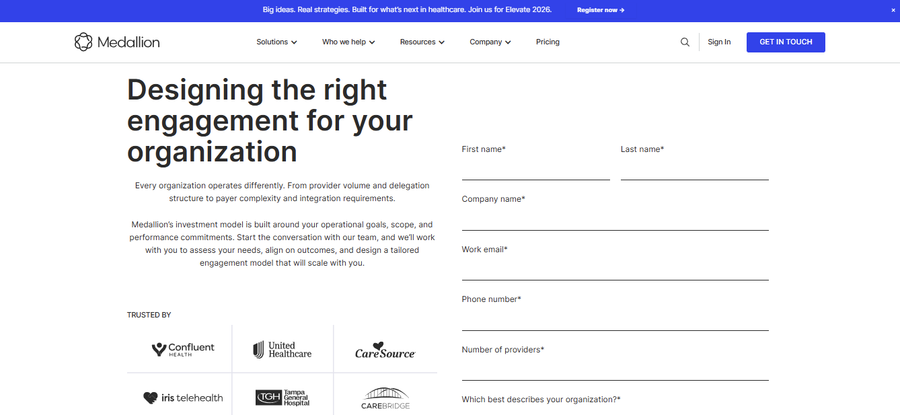
Medallion's pricing is custom-quoted based on provider volume, delegation structure, payer complexity, integration requirements, and the mix of services included (CVO, enrollment, licensing, monitoring, privileging).
Medallion's own ROI claims. Medallion's e-book benchmarks itself at 49.8% cost savings and 78% faster operations versus traditional in-house methods. The Headspace case study reports a 60% reduction in time the team spends on credentialing.
In Medallion's worked example, an organization currently spending around $750,000 annually on credentialing tools and staff would move to a Medallion-based model at roughly $376,380 per year: a $373,620 savings, or a 49.8% reduction. Medallion frames the FTE side as either reduction or, more commonly, reallocation of staff to provider-facing or revenue-related work.
These are vendor-reported figures based on Medallion's own ROI model rather than independent validation. The cost of delay. The other side of the ROI math is the delay cost. A single day of credentialing delay costs a medical group an average of $10,122 in lost revenue, according to a 2019 Merritt Hawkins survey cited by MGMA.
Medallion's pricing sits in the upper range of credentialing platform options. The investment is typically justified by the ROI math above, but buyers should expect a custom quote process before getting firm numbers.
What Medallion reviews actually say
Verified Medallion reviews on G2 and Capterra come from network ops managers, licensing coordinators, and revenue cycle directors who use the platform every day. Here's where it delivers and where it falls short.
What Medallion does well
The all-in-one model consolidates vendor sprawl
The single most-cited reason customers pick Medallion is consolidation. Irina S., a Network Ops Manager in mental health care, mentioned Medallion is an "all-in-one suite of services — credentialing, payer enrollment, licensing," replacing what would otherwise be three separate contracts.
The platform is easy to use and navigate
Brent B., a Director of Medical Staff Operations at a medical practice, mentions that Medallion has an "easy to use UI, excellent support staff." Another review echoes the point, mentioning that dashboard transparency and request submission flows are simple to use.
Strongest fit for delegated credentialing at scale
Medallion's strongest vertical signal is in delegated credentialing. Anna F., Director of Delegated Credentialing and Enrollment, says for organizations pursuing delegated credentialing or planning on obtaining it, "Medallion is a must."
Medallion's published case study with Tampa General Hospital reports $2.4M in ROI within the first six months of engagement (Medallion's footnote breaks this out as $2.3M in operational ROI plus $100K in software cost savings).
The platform is stable and the API is reliable
For organizations integrating Medallion into existing systems, platform stability and API reliability are make-or-break. Sean C., a VP of Marketing and Program Management at a hospital and healthcare organization, reports that the platform is "stable and our API connection hasn't failed" in their usage.
Onboarding is fast for new customers
Kit K., a Revenue Operations Manager, writes "Onboarding was quick and easy," with Medallion exceeding expectations as her second credentialing vendor. For organizations switching credentialing vendors, this matters more than feature comparisons. A smooth handoff in the first weeks predicts whether the rollout will succeed or stall.
Where Medallion falls short
CAQH data ingestion is incomplete
Medallion pulls from CAQH ProView to pre-populate provider profiles, but the integration doesn't reliably bring over all fields. Jennifer F., a Managed Care Coordinator at a hospital, mentions the "CAQH pull doesn't pull all information over." For practices that selected Medallion partly to skip manual CAQH work, this is a notable gap.
Quality, consistency, and contracting delays are real concerns
For provider groups whose business depends on credentialed clinicians' billing, these timeline failures translate to real revenue loss. Jana S., a Medical Operations Manager, says the "Quality of work is subpar," citing constant turnover on her account that creates errors and erodes provider trust.
Lisa W., a Medical Staff Credentialing Coordinator, writes that some of her providers are still not contracted after around two years. For provider groups whose revenue depends on credentialed clinicians, that's not a minor inconvenience.
Customization is limited across profiles, reporting, and credentialing files
The platform's "configure within our framework" approach works for organizations whose workflows fit the defaults. A verified user in hospital and healthcare notes that "reporting is currently minimal," and the report builder isn't template or roster-friendly.
Irina S. also mentions a "lack of ability to customize profiles, reporting, credentialing files, data fields." For organizations with specialty-specific data needs, unique compliance requirements, or custom reporting demands, this determines whether Medallion fits at all.
Medallion alternatives worth considering
If Medallion's managed-platform model doesn't match your team's actual needs or operational philosophy, these are the alternatives worth evaluating depending on what you're trying to solve.
Assured: AI-first credentialing platform positioned as a higher-touch alternative to Medallion, with multi-state licensing and workflow customization. Better suited for organizations that want a managed service with more configurability, though Assured's scale and market presence are smaller than Medallion's.
CertifyOS: API-first credentialing platform focused on automated primary source verification and provider data infrastructure. Best fit for health organizations wanting deeper system integration.
Modio Health: Credentialing software with strong document management, often selected by mid-sized practices wanting software without the full managed-service model.
Kaizen: Browser automation platform that runs credentialing workflows (CAQH attestations, payer enrollment submissions, and license renewal filings) directly in the portal, without migrating your operation into a new platform. The right fit for teams that want to keep their existing process and eliminate the manual execution layer.
Is Medallion worth the cost?
Medallion is worth the cost for digital health companies, large health systems, and provider groups that want a fully managed credentialing platform with expert oversight. For teams that need customization, deep integration, or operational ownership of credentialing, the platform model creates structural friction.
Skip the build cycle, automate the work
If your team's work is logging into CAQH for attestations, submitting payer enrollment applications through Availity and payer-specific portals, and tracking license renewals across state boards, you don't need to migrate your credentialing operation to a managed platform.
Kaizen runs these workflows directly in the browser. A credentialing manager can upload a CSV, trigger a workflow, and have updates completed across CAQH, payer portals, and state licensing boards without rebuilding their process inside a new platform.
Kaizen is HIPAA-compliant with a SOC 2 Type 2 audit in progress. Most teams have a first workflow live in under an hour. Book a call to see how it automates your existing credentialing workflows.
Frequently asked questions
Is Medallion good for delegated credentialing?
Yes, Medallion is good for delegated credentialing. Its infrastructure, with NCQA-certified workflows, automated primary source verification, and reportable committee management, is purpose-built for health systems and large provider groups running delegated payer agreements. It's the use case the platform is most clearly designed around.
What is the best Medallion alternative for credentialing?
The best Medallion alternative depends on what you need. For teams wanting a managed credentialing platform with more customization, CertifyOS is a direct alternative. For teams that want to automate browser-based credentialing work without migrating to a new platform, Kaizen runs CAQH, payer enrollment, and license tracking workflows directly.
Is Medallion right for multi-state provider operations?
Yes, Medallion is well-suited for multi-state provider operations, particularly organizations that want credentialing, licensing, and enrollment handled under one managed platform. Where it creates friction is customization: teams with specialty-specific workflows or existing systems they want to keep may hit the platform's configuration limits.