5 Simple Fractal alternatives: At a glance
Why look for Simple Fractal alternatives?
Simple Fractal has earned its position in ABA with nearly a decade of operating history and a customer base that includes some of the largest ABA networks in the country. The custom bot model handles maintenance well and covers workflows most platform tools won't touch.
Practices typically start looking elsewhere when:
- Scoping cycles slow new workflow adoption. Every new bot is another statement of work (SOW) and build cycle. As practices grow, the per-workflow process adds up.
- AI-native tools deploy faster. Newer platforms launch workflows in days using plain-English configuration instead of bot scripting, flipping the buy-versus-custom math.
- Specialized tools own sub-workflows. Prior authorization alone has produced AI-first products that do one job better than custom development.
TL;DR: Which Simple Fractal alternative should you choose?
Choose Silna if prior auth and benefit verification are the single biggest bottleneck. Not a fit if you need broad back-office automation beyond the front-end revenue cycle.
Choose UiPath if you have internal RPA engineers or a system integrator partner already and want maximum platform flexibility. Not a fit if you don't have IT resources to build healthcare-specific workflows from scratch.
Choose Kaizen if you need automation across multiple payer portals, credentialing systems, and back-office workflows in plain English. Not a fit if your core workflows depend on desktop-only systems.
Choose Tennr if referral intake and faxed documents are your biggest operational drag. Not a fit if your bottleneck is payer portal work or credentialing.
Choose Infinitus if payer phone calls (benefits checks, prior auth follow-up) eat the most staff hours. Not a fit if your workflows are primarily portal or document-based.
Stick with Simple Fractal if your existing bots are running smoothly, your team values the custom-scoped approach with maintenance included, and your workflows don't map cleanly to any platform tool. Wholesale migration rarely makes sense for working automation.
5 best Simple Fractal alternatives
1. Silna Health
Silna Health is the closest direct alternative to Simple Fractal for ABA prior authorization and front-end revenue cycle work. It caters specifically to specialty practices (ABA, OT, PT, speech, and behavioral health).
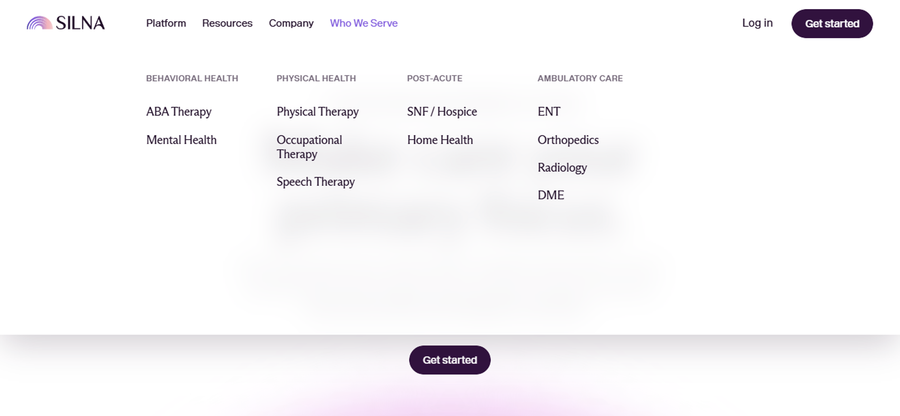
Silna Health automates prior authorization submission and tracking, benefit verification, and ongoing eligibility monitoring. Operational in 50 states with 1,000+ payors supported.
Key features:
- AI-powered prior auth submission: Submits, tracks, and follows up automatically with a claimed 99.8% success rate
- Specialty-specific benefit verification: Checks coverage, accumulations, authorization requirements, and visit limits in seconds instead of 30 minutes
- Ongoing eligibility monitoring: Continuously checks that each patient plan is active and flags lost coverage or new plans
- Payer-tuned rules engine: Handles state-by-state and payer-by-payer documentation variation
Pros:
- Deep ABA specialty focus, not generic healthcare automation
- Lighter integration footprint than full RCM platforms; connects to existing EHRs without requiring a deep system rebuild
- Significant traction in the ABA community with major VC backing
Cons:
- Narrow scope: doesn't cover credentialing, payroll, scheduling, or general back-office work
- Relatively new platform; the Care Readiness Platform launched in March 2025, so customer-history depth is limited compared to legacy RPA vendors
- Hybrid AI plus human ops means some workflows still depend on Silna's in-house team for completion
Best for: ABA practices where prior auth is the biggest bottleneck; specialty practices wanting AI-first automation without platform migration; teams that don't want deep integration projects.
Pricing: Custom pricing (request quote); sales conversation required.
2. UiPath
UiPath is the market-leading enterprise RPA platform and a comprehensive bot-building studio. It can technically automate any payer portal, clinical field, or billing workflow given enough development time.
Key features:
- Studio bot-building environment: Industry-standard visual designer for RPA development
- Massive integration ecosystem: Thousands of pre-built connectors and marketplace integrations
- Attended and unattended robots: Covers both desktop-side automation and server-side execution
- Process mining and analytics: Identifies automation candidates across existing workflows
Pros:
- Mature platform with broad partner and training ecosystem
- Industry-agnostic flexibility for organizations automating across departments
- Strong governance features for regulated industries
Cons:
- No healthcare-specific templates out of the box
- Bots break when payer portal layouts change and need constant maintenance
- Pricing complexity (Unified Pricing vs Flex models, Platform Units, AI Units) makes total cost hard to predict
Best for: Multi-state ABA networks with dedicated automation engineers; healthcare organizations already standardized on UiPath across departments; enterprises with internal RPA centers of excellence.
Pricing: Starts at $25/month for Basic; Standard and Enterprise are contact sales. Production deployments can run high five-figures to six-figures annually once Platform Units, robot licenses, and add-ons are included.
3. Kaizen
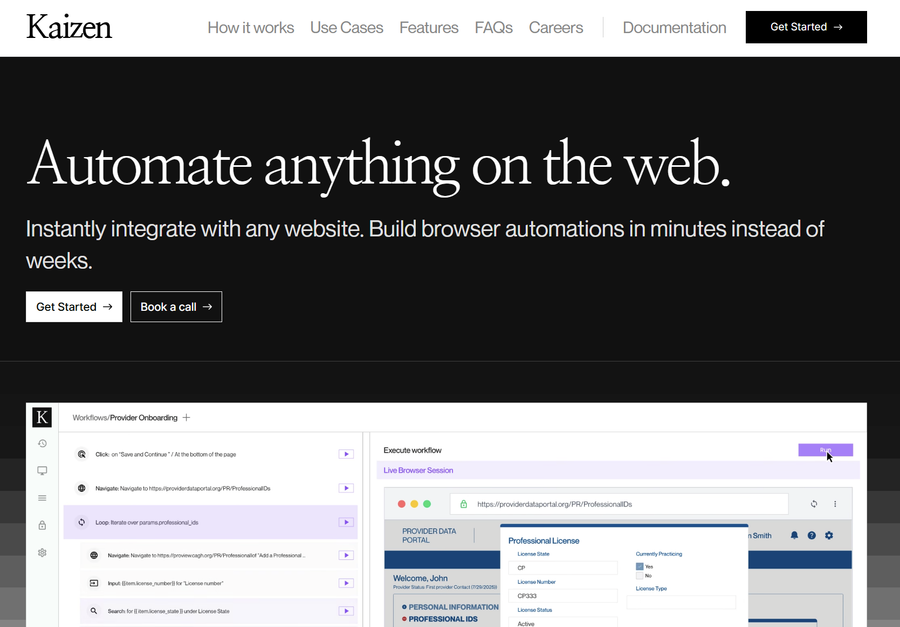
Kaizen is a full-scale automation platform built for the web-based workflows healthcare ops teams run every day. It handles credentialing, prior authorization, verification of benefits, claims-status checks, and patient intake across any payer portal or practice system without code, without custom bot builds, and without waiting on engineering.
Key features:
- Plain-English workflow definition: Non-technical ops leaders can write and edit workflows without scripting bots
- Self-healing browser agents: Adapt to portal layout changes instead of breaking when payers update their interfaces
- Built-in 2FA and CAPTCHA handling: Logs into payer portals the way a credentialing specialist would
- Output integration: Results push to Google Sheets, Slack, or via API to existing billing systems
Pros:
- Purpose-built for healthcare portal work, not generic RPA repurposed for it
- Plain-English configuration eliminates the bot-scripting bottleneck
- HIPAA compliant with enterprise-grade encryption; SOC 2 Type 2 in progress
Cons:
- Doesn't work with desktop-only systems
- Social media platforms aren't supported due to aggressive anti-bot measures
- Not built as a hands-off managed service; Kaizen runs the automation while your team stays in the loop on workflow definitions and triggers, with hands-on support
Best for: ABA, autism therapy, and digital health teams running multiple payer portal workflows; credentialing teams managing providers across CAQH, Availity, and payer-specific portals; practices that want broad automation, not just prior auth.
Pricing: ROI-based pricing typically around one-third of the labor cost being replaced. Free POC and a one-month paid pilot available.
4. Tennr
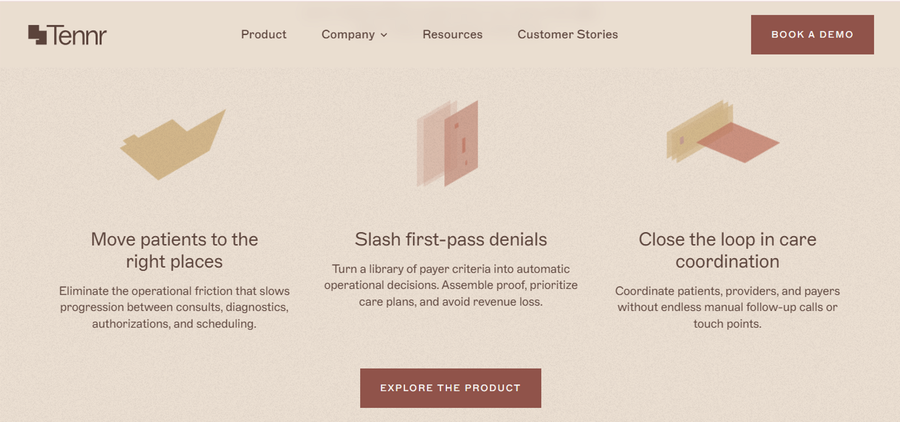
Tennr is a healthcare AI platform built for the referral, intake, and document-heavy workflows that drive specialty care, including ABA. The platform processes over 10 million healthcare documents per month using proprietary language models (RaeLM) that read referrals, parse faxes and PDFs, run insurance verification, and route patients through intake.
Key features:
- Document AI for referrals: Reads inbound faxes, PDFs, and emails to extract patient data and route through intake automatically
- Insurance verification: Verifies coverage and benefits as part of the referral processing flow
- Voice AI calling: Automates routine payer and patient calls, including benefits investigations and documentation follow-ups
- Prior auth automation: Submits and tracks prior auths tied to referral workflows
Pros:
- Purpose-built for the fax-and-PDF reality of specialty referrals, including ABA practices
- AI-native approach with proprietary language models trained on medical documents
- Voice AI calling addresses phone-based bottlenecks, automating payer benefits checks and patient outreach calls without adding headcount
Cons:
- Narrower focus on front-office referral and intake than broader platform tools
- Doesn't cover credentialing or back-office payer portal work the way browser-first platforms do
- Custom pricing makes total cost comparison difficult against transparent platform options
Best for: ABA and specialty practices buried in faxed referrals and document intake; teams where routine phone calls to payers are a major operational bottleneck; practices wanting AI-native automation rather than scripted RPA or managed BPO work.
Pricing: Custom quotes based on document volume and scope; sales conversation required.
5. Infinitus
Infinitus is a voice AI platform that automates the phone calls healthcare ops teams make to payers, providers, and patients. AI agents handle benefits verification, prior auth follow-up, and patient access calls, freeing staff from hours-long holds.
Key features:
- Voice AI agents: Make outbound calls to payers, providers, and patients for benefits verification, prior auth follow-up, and referral coordination
- No-code agent builder (Studio): Healthcare teams design, test, and deploy custom voice agents with built-in compliance guardrails
- API integration: Results flow back into existing systems of record or the Infinitus portal
- Healthcare-specific training: Agents trained on 1,000+ therapies and the right questions to push back when payer reps have incorrect information
Pros:
- Phone-based workflows like benefits verification and prior auth follow-up are the bottleneck nothing else on this list addresses
- Purpose-built for healthcare rather than a general voice AI platform adapted for it
- No-code agent builder lets ops teams configure new call workflows without engineering support
Cons:
- Voice-only scope means it doesn't touch portal-based work like credentialing or claims submission
- Enterprise pharma and biotech focus may be heavier than smaller ABA practices need
- Custom pricing makes the total cost difficult to compare against transparent platform options
Best for: Practices where payer phone calls (benefits checks, prior auth follow-up) are the biggest time sink; specialty pharmacy and patient access teams running high call volumes; organizations pairing voice automation with portal automation rather than replacing one with the other.
Pricing: Custom, enterprise volume-based quotes; sales conversation required.
How to evaluate Simple Fractal alternatives
The marketing pages all sound similar. Here's what matters when picking a replacement.
- Healthcare specificity. Generic RPA can technically do this work, but you'll either pay a system integrator to build it or build it yourself. Healthcare-specific platforms come with domain expertise embedded.
- Workflow scope you actually need. If prior auth is 80% of the pain, a narrow tool fits. If credentialing, billing, and portal work all hurt equally, you need broader coverage.
- Deployment and maintenance model. Custom bot vendors include maintenance, but platform tools often don't. Figure out who owns it when a payer portal changes its layout, because that will happen.
- HIPAA, SOC 2, and BAA readiness. Confirm the BAA process before the trial starts, not after.
- Workflow definition method. Plain-English configuration lets non-technical ops leaders build directly. Bot scripting concentrates capacity in your automation engineer.
- Time-to-first-workflow. Ask for specific customer examples in your specialty, and how long the second workflow took versus the first.
- Honest pricing model. ROI-based, per-bot, per-user, and percentage-of-collections all compound differently at scale. Build a 24-month total cost projection before signing.
Match the tool to the work, not the marketing
The market has caught up. What used to be a default choice is now a real evaluation against purpose-built alternatives. For most ABA practices, the answer is picking the right tool for each workflow.
Kaizen for the browser-based payer portal work that eats your team's day. Silna for prior auth. Tennr for referrals and intake. Infinitus for payer phone calls. Simple Fractal for what's already running smoothly. Generic RPA only if your IT investment can support it.
Still piecing together a stack of specialty tools while your portal work keeps piling up? Book a call to see how we handle your portal workflows.
Frequently asked questions
What is the best Simple Fractal alternative for ABA practices?
The best Simple Fractal alternative depends on which workflow hurts most. Silna is the strongest fit for ABA prior auth, Kaizen handles broad payer-portal and credentialing work, Tennr automates referral intake, and Infinitus tackles payer phone calls. Most ABA practices end up combining two or three tools rather than replacing Simple Fractal with a single platform.
Can AI tools replace Simple Fractal for ABA prior auth?
Yes, AI tools can replace Simple Fractal for ABA prior auth in most cases. Silna is purpose-built for ABA and specialty practice prior authorization, with faster deployment than custom bot development. The tradeoff is a narrower scope, since Silna doesn't cover credentialing, scheduling, or general back-office work the way Simple Fractal can.
Do I need to switch from Simple Fractal completely?
No, most ABA practices don't need to switch from Simple Fractal completely. If existing bots are running smoothly and maintenance is included in the contract, wholesale migration rarely makes sense. The stronger move is layering newer AI tools like Silna, Kaizen, or Tennr onto specific workflows where Simple Fractal scoping cycles slow new automation adoption.