What is Simple Fractal?
Simple Fractal is a custom robotic process automation (RPA) consultancy that builds bespoke bots for healthcare ops teams, with a specialty focus on ABA, mental health, and home health.

Rather than selling a platform that customers configure on their own, Simple Fractal designs, builds, and maintains custom-scripted bots scoped per engagement and quoted post-discovery.
Simple Fractal features
Here's how Simple Fractal's capabilities map to credentialing, prior auth, and RCM work, and where the custom-build model creates friction.
Custom RPA development
This is Simple Fractal's core offering and a genuine fit for unique workflows that off-the-shelf tools don't cover well. A credentialing team with a non-standard payer enrollment process or an ABA practice with a specialty-specific billing rule gets a bot scoped exactly to their needs.
The tradeoff is that every new workflow restarts the discovery cycle. Each new bot is a new scope, statement of work, and build cycle. The per-unit cost doesn't shrink much as you scale, which can catch growing practices off guard.
Turnkey bot products (Presley, Reggie, Remy, Archie, Connie)
These are the five workflows they've already built for: patient responsibility billing, California Regional Center billing, appointment reminders, unconverted appointment recovery, and scheduling.
The limitation is that the named bots solve one specific workflow each. A practice that needs prior auth automation, claims-status tracking, or credentialing work is back to custom development.
Human-in-the-loop automation
This combines bot execution with operations team review for workflows that can't be fully automated. Useful for ambiguous claims work, complex appeals, or high-dollar transactions where a person should validate the bot's output.
The tradeoff is that the "human" in the loop is Simple Fractal's offshore or in-house operations team, which adds variable cost and creates a dependency on their staffing capacity rather than yours.
Operational intelligence dashboards
Layer reporting and analytics on top of the automated workflows. Useful for executives who need visibility into bot performance, throughput, and ROI for budget justification.
It's a separate add-on rather than a built-in feature. Most ops teams don't need a dashboard layer to confirm that a bot is running, so the cost is harder to justify outside large enterprises with dedicated automation programs.
Clearinghouse and RCM integrations
Simple Fractal integrates its bots with billing systems, claims processing, and clearinghouse workflows. This is where Simple Fractal's vertical focus shows, particularly in ABA and mental health RCM, where Regional Center billing, therapy authorization rules, and specialty CPT coding reward domain familiarity.
Integrations are built per engagement, though. Adding a new payer relationship, a new clearinghouse, or a new billing system means a new scope of work.
Data infrastructure and warehousing
Support reporting and analytics on automated workflow data. Useful for large enterprises that want to centralize operational data alongside the bot output. This is consultancy-style data engineering work and not a self-serve product.
The cost reflects bespoke development time, which makes it hard to justify for ops teams focused on the automation itself rather than a broader data strategy.
Simple Fractal pricing: What healthcare teams actually pay
Simple Fractal doesn't publish pricing. Quotes are provided post-discovery, and the company offers flexible models, including project-based, subscription, and performance-based engagements.
The figures below are based on industry RPA benchmarks and Simple Fractal's publicly stated engagement model.
- Custom RPA builds. Industry benchmarks put simple bot development at $2,000–$8,000 per process, with complex multi-system builds at $15,000–$40,000. Mid-range RPA implementations land in $50,000–$150,000 overall, and Simple Fractal's quotes likely sit within that band, scaled to bot scope.
- Turnkey bot subscriptions. Pricing for the named bots (Presley, Reggie, Remy, Archie, Connie) is not published. Customers report these as subscription-priced rather than project-priced, with lower upfront cost than custom builds.
- Performance-based engagements. Pricing tied to outcomes (recovered dollars, transactions processed). Lower upfront commitment, but variable cost can outrun fixed-fee pricing at scale.
- Ongoing maintenance. General RPA industry benchmarks put maintenance at 15–25% of initial development costs annually. Simple Fractal includes maintenance in many engagements, though new workflows or major system changes trigger new scope.
For healthcare ops teams running credentialing, prior auth, and verification of benefits workflows, the entry point is usually a custom build engagement, with discovery and first-bot deployment taking four to eight weeks before production.
What Simple Fractal reviews say
What Simple Fractal does well
Documented ROI on specific named-bot workflows
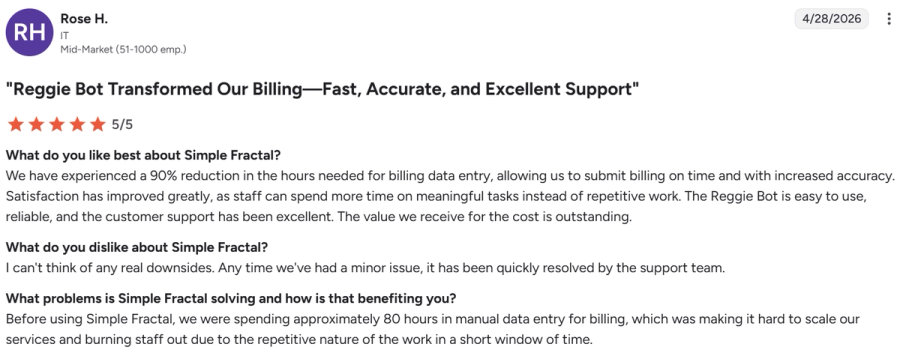
Rose H., IT staff at a mid-market organization, reports "a 90% reduction in the hours needed for billing data entry" after deploying the Reggie bot. The result is real, but it's tied to one prebuilt workflow. The ROI shows up when a team's needs map to a bot Simple Fractal has already built.
Deep domain expertise in ABA, mental health, and home health
Haley C., a CFO in mental health care, credits Simple Fractal's "impressive depth of knowledge" with scoping a solution that exceeded her organization's anticipated ROI.
Rebecca B., a Chief Operating Officer at an enterprise organization, notes the team enhances original plans for better results rather than executing to spec.
Bots compound in value at enterprise scale
Scott D., a Chief Information Officer in IT services, notes that "each new bot delivered became a foundational underpinning for the next one." For enterprises running five or more workflows, later bots share logic and data pipelines from earlier builds rather than starting from scratch.
That compounding only kicks in at volume, though. Teams running one or two workflows rarely reach the scale where the architecture pays off.
Where Simple Fractal falls short
Premium pricing causes executive friction
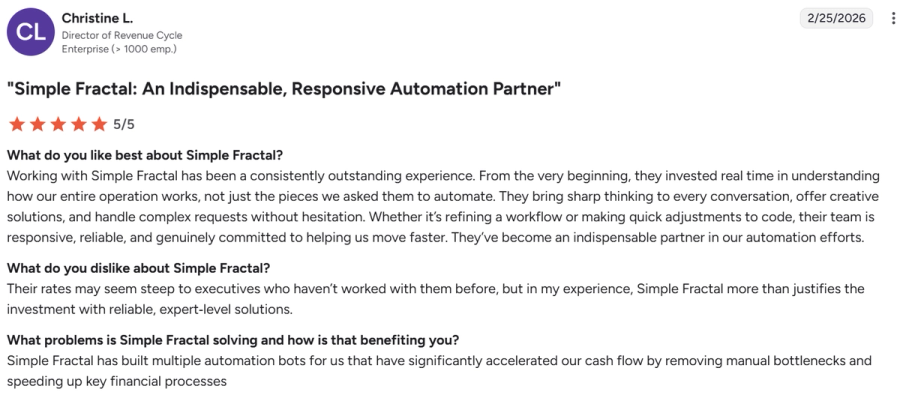
Christine L., a Director of Revenue Cycle at an enterprise organization, says "rates may seem steep to executives who haven't worked with them before."
Development timelines can stretch beyond expectations
Haley C. added that "the timeline for the development phase was drawn out longer than we expected," partly due to scope changes on her side.
Ops teams under pressure from payer contract changes or compliance deadlines can find the multi-week discovery and build cycle a real cost, delaying operational improvements.
Documentation gaps during development
A verified user in professional training and coaching mentioned that "they could improve their documentation throughout the process," adding that detailed technical documentation is provided on request, but isn't standard practice. For organizations that need to maintain bots independently after handoff, the gap shows up.
Simple Fractal alternatives worth considering
If Simple Fractal's custom-built model doesn't match your workload or timeline, three are worth evaluating:
- Silna Health: Best for ABA practices where prior auth is the biggest bottleneck. AI-first platform focused on prior auth, benefit verification, and eligibility monitoring, backed by a $22M Series A in 2025 (Accel, Bain Capital Ventures), with $27M in total funding.
- UiPath: Best for enterprises with internal RPA teams and the technical capacity to configure and maintain a broad platform. Starts at $25/month but production deployments routinely hit six figures annually. No ABA-specific templates out of the box.
- Kaizen: Best for healthcare ops teams running CAQH, Availity, payer portals, and state licensing workflows. Plain-English configuration deploys in days, with ROI-based pricing rather than per-bot licensing.
Is Simple Fractal worth the investment?
Simple Fractal is worth the cost for ABA, mental health, and home-health practices with workflows that match their named bots or operations unique enough to justify a custom build. For teams that fit one of those molds, the domain expertise and build quality that reviewers praise are real.
It's a poorer fit for teams whose core workload is browser-based portal navigation. When most of the work is logging into CAQH, checking auth status on Availity, or running credentialing updates across United and Aetna, a custom RPA build adds discovery time and per-workflow cost without adding coverage that's actually needed.
Those workflows don't require bespoke development. Instead, they require a platform already built for the web. That's the line where the custom build model becomes the more expensive path, and where a browser-first tool like Kaizen tends to win.
The faster path for portal-heavy ops
If your team's work is logging into payer portals, submitting prior auths, and updating credentialing data across CAQH, Availity, United, and Aetna, you don't need a custom RPA build cycle to get started.
Kaizen runs these workflows directly in the browser. A credentialing manager can upload a CSV, trigger a workflow, and have updates completed across multiple payer portals without scoping a custom bot or waiting through a multi-week discovery process.
Still scoping a new bot every time your portal workflows change? Book a call to see how we run your existing portal workflows.
Frequently asked questions
Is Simple Fractal good for prior authorization and payer portal work?
Simple Fractal is good for prior authorization through custom bot development, but it isn't built for browser-based payer portal work at scale. For teams whose core work is navigating Availity, United, or Aetna, a browser-first platform avoids the multi-week discovery cycle that custom RPA requires.
What is the best Simple Fractal alternative for healthcare payer portals?
The best Simple Fractal alternative for healthcare payer portals is Kaizen. It runs in secure cloud browsers, handles 2FA natively, and lets non-technical ops leaders define workflows in plain English. Most customers have a first workflow live in days.
Is Simple Fractal worth the investment for ABA practices?
Sometimes. Simple Fractal is worth it for ABA practices whose workflows match their named bots (patient responsibility billing, Regional Center billing, appointment reminders) or whose needs justify a multi-week custom build. It's a weaker fit for practices focused on prior auth or broad portal work, where Silna or Kaizen typically delivers faster ROI.